
Are We Still Testing Students Fairly? The Listening Exam Question Schools Need to Ask
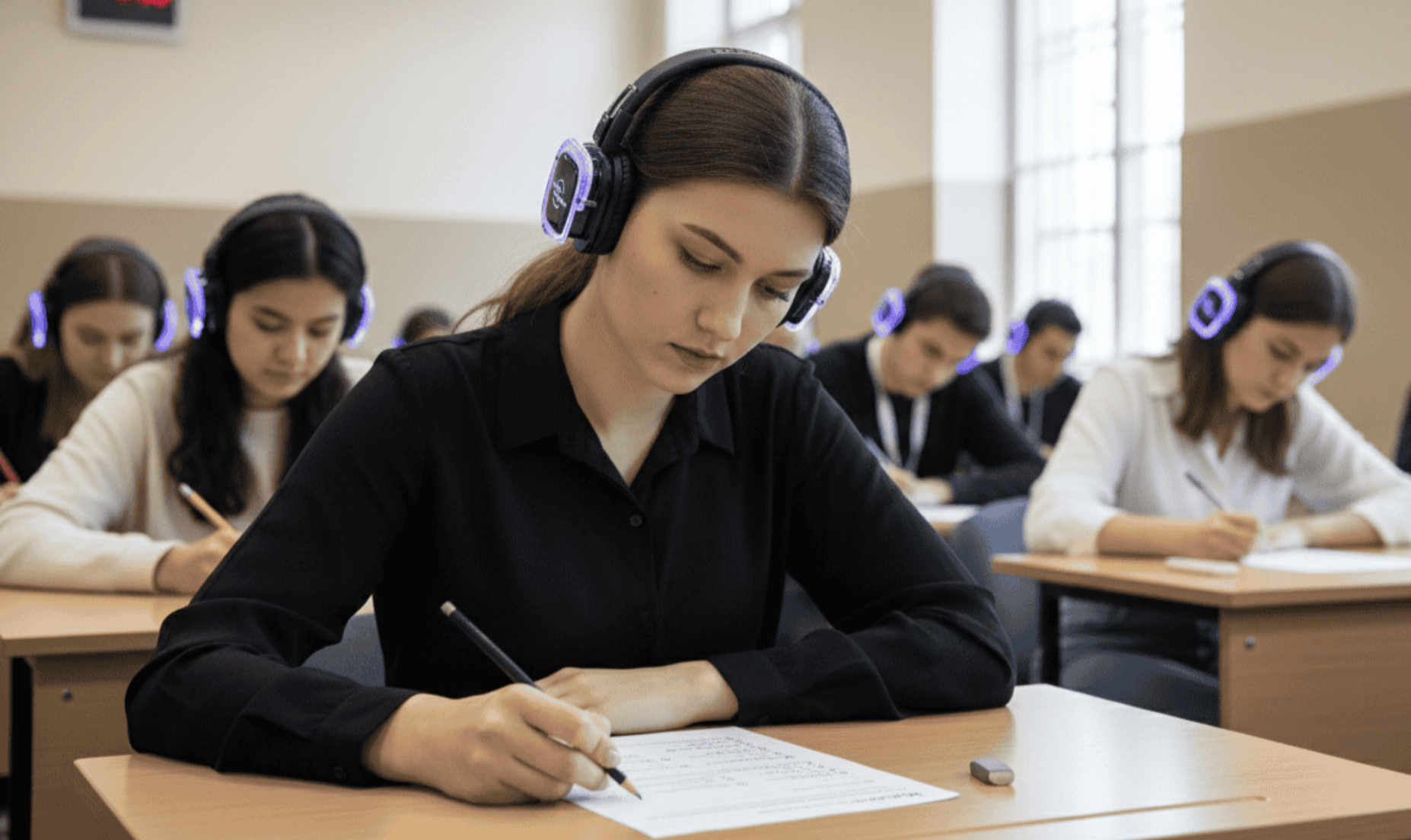
“Can everyone hear clearly?” It’s probably the last question an exams officer asks before pressing play. Yet it might be the most important question of the entire assessment. Every summer, thousands of students across the UK sit listening exams that could influence college applications, university offers and future career opportunities. The papers are carefully moderated. The timing is tightly controlled. Invigilators follow strict procedures. Every effort is made to ensure fairness.
And yet, in many schools, one variable remains almost entirely outside anyone’s control.
The room. Some students hear every word with perfect clarity. Others are battling echoes, background noise or speakers positioned thirty metres away in a sports hall. They’re all sitting the same paper.
But are they really sitting the same exam?
As education continues to place greater emphasis on inclusion, accessibility and equality, more schools are beginning to ask whether traditional listening exams still provide the consistent experience every student deserves. Perhaps the question isn’t whether the assessment is fair on paper. Perhaps it’s whether the environment allows every student an equal opportunity to demonstrate what they know.
A Problem Hidden in Plain Sight
Walk into almost any listening exam and nothing appears unusual.
Rows of desks. Silence. A recording playing through speakers. Students concentrating.
It’s a setup we’ve accepted for decades, largely because there hasn’t been an obvious alternative. But when you stop and think about it, the system raises some uncomfortable questions.
Should a student’s experience depend on where they’re sitting?
Should acoustics influence performance?
Should schools need six separate rooms simply because they’re running French, Spanish and German at the same time?
These aren’t hypothetical questions. They’re practical challenges faced by exams officers every year. Listening exams are designed to assess comprehension, vocabulary and language skills. They are not designed to test how well students can hear through poor acoustics, compete with background noise or concentrate despite distractions beyond their control.
Yet in many schools, those variables still exist.
The Reality Facing Schools
Exam season isn’t getting any easier. Schools are expected to accommodate growing student numbers while managing increasingly complex timetables and making the best possible use of limited teaching space. Many exam officers describe the same challenge. The sports hall is booked for written papers. Classrooms are occupied by practical assessments. Assembly halls are in constant use.
Meanwhile, listening exams still need quiet environments where every student can hear clearly.
The traditional solution has always been to find another room. Then another. Then another.
Eventually the challenge stops being the exam itself and becomes finding enough suitable spaces to deliver it.
That approach creates additional pressure on timetables, increases the demand for invigilators and limits how efficiently schools can use their facilities during one of the busiest periods of the academic year.
Rebecca Craine, Exams Officer at Westwood Academy, summed up the impact of changing their approach perfectly. “If I’d never used the headsets, I would have had to find eight different rooms and eight different invigilators. It was a game changer.”
What stands out about this quote is that it isn’t talking about sound quality. It’s talking about simplicity. By removing the need to separate multiple listening exams across different rooms, schools can reduce logistical pressures while creating a more consistent experience for every student. Sometimes the greatest improvements aren’t the most obvious ones.
What Happens When You Stop Designing Around Speakers?
For years, schools have organised listening exams around the limitations of loudspeakers. Students are moved into separate rooms. Extra invigilators are scheduled. Timetables become increasingly complicated. Not because the exams require it, but because the technology does.
Professional wireless audio changes that equation completely.
Instead of asking, “Which room can we use?” Schools can begin asking, “How can we make the best use of the space we already have?” It’s a subtle shift in thinking, but it changes everything.
Using professional wireless headset systems, multiple listening exams can take place in the same room without students hearing one another’s recordings. Foundation and Higher Tier papers can run simultaneously, alongside different languages, all within a single shared venue.
Sports halls, assembly halls and lecture theatres suddenly become far more flexible assessment spaces.
For schools, that means fewer rooms, simpler timetables and a more efficient use of resources.
The Feature Most Schools Don’t Know Exists
When schools first hear that multiple listening exams can run simultaneously in one room, the question is almost always the same. “How do you stop students changing channels?” The answer is channel locking. Before the exam begins, every headset is assigned to the correct audio channel and securely locked.
Students cannot accidentally or intentionally switch to another recording during the assessment. A French Foundation candidate hears only the French Foundation paper. A German Higher student remains on the German Higher recording. Spanish candidates stay on the correct language throughout the exam. For exams officers, this removes one more potential concern on a day already filled with moving parts.
It protects exam integrity while giving complete confidence that every student is completing the correct assessment from beginning to end. It’s a relatively simple feature.Yet it’s one of the reasons professional listening exam systems have become increasingly popular across schools, colleges and universities.
Inclusion Should Never Be an Afterthought
Education has made enormous progress in recognising that students learn, process information and engage with assessments in different ways. Assessment environments should reflect that progress. For some learners, background noise is simply an annoyance. For others, it becomes a genuine barrier.
Students with hearing difficulties.
Neurodivergent learners.
Candidates who struggle to concentrate in noisy environments.
Large echoing spaces can all introduce unnecessary challenges that have nothing to do with language ability. Professional wireless headsets deliver clear audio directly to every student while allowing individual volume adjustment, creating a calmer and more consistent listening experience.
Importantly, these improvements don’t benefit only students requiring additional support, they improve conditions for everyone. Good accessibility rarely serves one group alone, it raises standards across the entire classroom.
Looking Ahead: The Future of Listening Exams
Technology has transformed almost every aspect of education over the past two decades.
Classrooms have become increasingly digital. Learning resources are more accessible than ever before. Teaching methods continue to evolve in response to new research, changing student needs and advances in technology.
Listening exams have traditionally followed the same format for many years, largely because that’s how they’ve always been delivered. Yet as schools continue to prioritise accessibility, inclusion and equality, it’s worth asking whether the environments in which these assessments take place have evolved at the same pace. A student’s listening ability should never be influenced by poor acoustics, background noise or where they happen to be seated. Every candidate deserves the same opportunity to hear every word clearly, concentrate fully and demonstrate what they have learned under consistent conditions.
For schools, the conversation extends beyond audio quality alone. It is about making better use of available space, reducing unnecessary pressure on exam teams and creating assessment environments that work for students, teachers and exam officers alike. Features such as multi channel audio, channel locking and wireless headset technology are not simply technical improvements. They are practical solutions to challenges that schools have faced for years.
Perhaps most importantly, they allow education professionals to focus less on managing logistics and more on supporting students during one of the most important periods of their academic journey.
The experiences of schools already adopting professional listening exam systems demonstrate that the benefits extend far beyond the examination itself. More efficient timetables. Better use of school facilities. Simpler exam delivery. Greater confidence for invigilators. Improved accessibility for students with additional needs. These are meaningful operational improvements that positively influence the entire exam process.
As student numbers continue to grow and schools are expected to achieve more with the resources available, finding smarter ways to deliver assessments will become increasingly important. Technology will undoubtedly play a role, but only where it solves genuine problems and improves outcomes for everyone involved.
Ultimately, this isn’t really a conversation about wireless headsets. It’s a conversation about fairness.
It’s about ensuring that no student’s performance is affected by the room they’re sitting in, the distance from a loudspeaker or distractions they cannot control. It’s about recognising that equality in assessment is built from hundreds of small decisions, many of which begin long before the first exam paper is handed out.
The schools leading the way are no longer asking, “How do we run this listening exam?” They’re asking a far more important question. “How do we create the best possible conditions for every student to succeed?”
When that becomes the starting point, the technology simply becomes the tool that helps make it possible. Because at the heart of every listening exam is a simple principle that should never be compromised.
Every student deserves to hear the same opportunity.
We can provide wireless headphones for your next listening exam, helping students hear clearly, stay focused and experience a consistent listening environment.
Find out more about our listening exam solutions and how Silent Education can support your next assessment, or get in touch with the team to discuss your requirements.